
When it comes to protecting digital information with encryption, one of the most frequently mentioned algorithms is AES, or Advanced Encryption Standard.
Its 128-bit version is especially popular, having been successfully used for more than two decades, from banking systems to mobile messengers.
But what does “AES-128” actually mean, and how well does it cope with the task of protecting data?
What is AES-128?
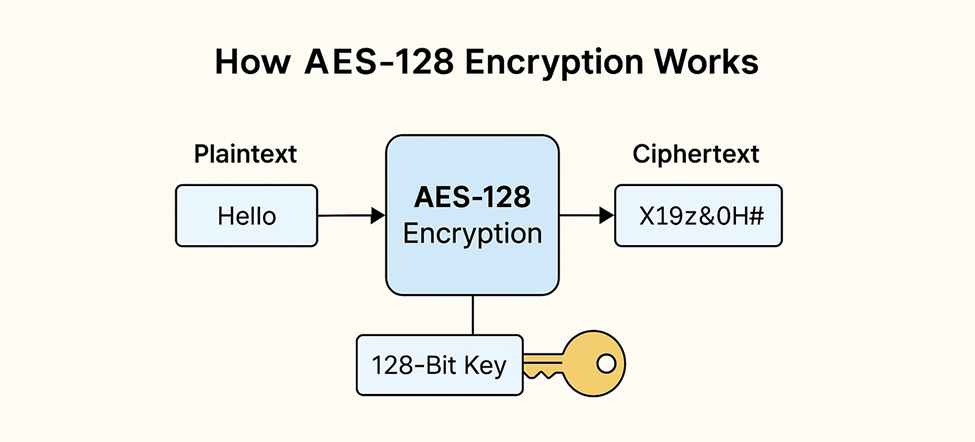
AES is a symmetric block cipher algorithm adopted as a standard by the US government in 2001. “Symmetric” means that the same key is used to both encrypt and decrypt data. In the AES-128 version, that key is exactly 128 bits, or 16 bytes, long.
AES encryption is done in stages. The data is broken down into 128-bit blocks, and each block goes through a series of rounds — 10 in the case of AES-128. Each round involves several operations: byte substitution, row swapping, column shuffling, and adding a round key. All of these steps are designed to obfuscate the original information as much as possible and eliminate the possibility of “reverse analysis” without the key.
What Is AES-128 Encryption Used For?
AES-128 encryption is ubiquitous—you’ve probably used it 100s of times today without even knowing it. Here are a few examples of places where it is used:
- SSL/TLS connections (after the connection is established using asymmetric encryption)
- VPN connections
- File encryption on smartphones
- Wi-Fi security (WPA2/WPA3)
- Bluetooth
- Database encryption
- File and backup encryption
Why 128 Bits?
The number 128 in the name reflects the size of the key used. Theoretically, to crack such a key, you need to try 2¹²⁸ possible combinations. This number is so huge that even the most powerful supercomputers would need billions of years to cope with such a task using “brute force”.
Although there are versions of AES with 192-bit and 256-bit keys, the 128-bit version remains the most common in practice due to its good balance between speed and security.
How Secure Is AES-128 In Reality?
To date, AES-128 has no known practical vulnerabilities that would allow encryption to be bypassed without knowledge of the key. All successful attacks on systems using AES are not related to the algorithm itself, but to its incorrect implementation – for example, with a key leak, weak passwords, or a lack of protection against side-channel attacks.
It is also important to understand that encryption security depends not only on the key, but also on the context in which it is used. For example, in secure connections (HTTPS), AES is used in conjunction with other technologies, such as TLS key exchange, which further strengthens the protection.
Conclusion
AES-128 remains a reliable and highly effective tool for protecting information. Despite the development of quantum technologies, today it provides more than sufficient security for most users and organizations, provided that the keys are implemented and stored correctly. This is one of those rare cases where simplicity and power go hand in hand.