
In the digital world, where data is transmitted, verified, and stored millions of times per second, there is one quiet but vital technology: the hash function.
One of the most secure and widely used today is SHA-256, part of the SHA-2 family.
What Is SHA-256?
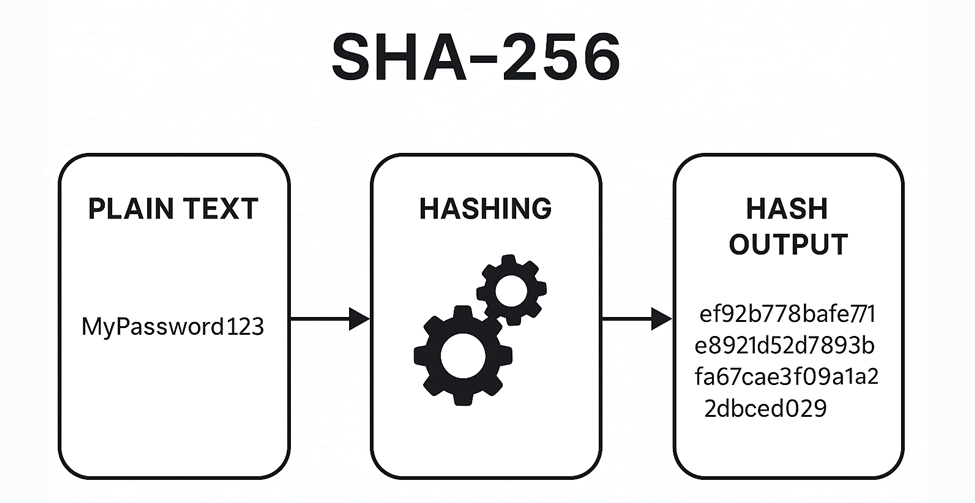
SHA stands for Secure Hash Algorithm. Its job is simple but critical: take any input data, from a single word to an entire book, and turn it into a fixed-length string. In the case of SHA-256, the result will always be a 256-bit (or 64-character hexadecimal) code.
For example, applying the SHA-256 algorithm turns this string into the following hash value:
testpassword -> 9f735e0df9a1ddc702bf0a1a7b83033f9f7153a0dadc9957289b05
Two Important Things to Know About Hash Functions:
- The first thing to know is that a hash function is irreversible. You can’t take a hash and use it to restore the original data. In other words, you can’t “decrypt” a hash to get the original value.
- Hash functions like SHA-256 are used for verifying the integrity of information: if two files produce the same hash, they are identical – there is no other way. Even the slightest change in the input data results in a completely different hash – this is called the avalanche effect.
SHA-2 Algorithms Are More Secure Than SHA-1
The SHA-2 family, which includes the SHA-256 algorithm, replaced the outdated and insecure SHA-1. The latter was vulnerable to so-called collisions — cases where different data produces the same hash. In 2017, Google proved that such collisions were not only theoretically possible — they could be created in practice. This was the final point: since then, the transition to SHA-2 has become the standard in browsers, SSL certificates, cryptography, and blockchain.
Where Is SHA-256 Used?
SHA-256 is particularly popular due to its robustness and wide application. For example, it is used in:
- blockchain technology (including Bitcoin)
- digital signatures (document signing, code signing, etc.)
- security certificates (including SSL certificates)
- version control systems
- to store passwords in databases (in combination with salts*)
- And many more
It is important to understand: SHA-256 is not encryption. It does not contain the actual data, but only creates a unique “fingerprint” of the data. It is not used to protect against interception, but it does a great job of detecting counterfeiting and distortion.
In simple terms, SHA-256 is a digital identifier: invisible but unforgeable. It does not store the contents of the document, but can be used to prove that it has not been tampered with.
*A “salt” is a random string added to a password before hashing to make each hash unique, even if two users choose the same password. This helps protect against precomputed attacks like hash or rainbow tables.