

 Loading...
Encryption is the basis of information security today because it allows you to reliably protect data from unauthorized access.
Among the many encryption methods, RSA and AES are the two of most popular, but they work completely differently and solve different problems.
Let’s examine how they differ, where they are used, and which method is best suited for your purposes.
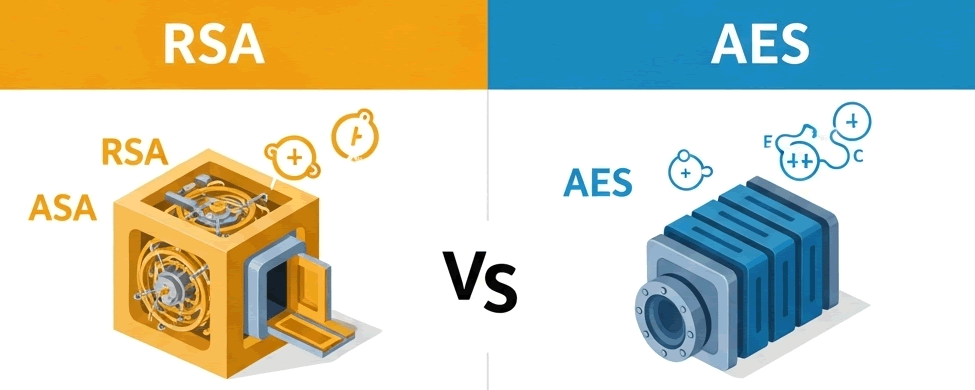
What is RSA?
RSA (named after its creators: Rivest, Shamir, and Adleman) appeared in 1977 and was the first practical method of asymmetric encryption. This scheme uses two pairs of keys: one public, to encrypt data, and one private, to decrypt it. This design allows secure transmission of information even over unprotected channels (like the internet).
The reliability of RSA is based on a mathematical problem – the factorization of large prime numbers, which makes hacking extremely difficult. Today, RSA is used for secure data transfer on the Internet, digital signatures, and in SSL certificate technology that protects websites.
What is AES?
AES (Advanced Encryption Standard) is a symmetric encryption algorithm approved by the US National Institute of Standards and Technology (NIST) in 2001. Unlike RSA, it uses the same key for encryption and decryption.
AES is faster and more efficient than asymmetric methods, especially when processing large amounts of information. The standard block length is 128 bits, and the key can be 128, 192, or 256 bits, depending on the level of security required. Due to its speed, AES is widely used to protect files, Wi-Fi networks, and VPN connections.
When used over insecure channels (like the internet), AES must be used together with asymmetric encryption such as RSA.
A Brief Comparison of RSA and AES
| Characteristics | RSA | AES |
| Encryption type | Asymmetric | Symmetric |
| Key length | 2048, 3072, 4096 bits | 128, 192, 256 bits |
| Processing speed | Slowly | Faster |
| Main applications | Signatures, Key Exchange, SSL | File protection, VPN, wireless networks |
Key differences
Asymmetry vs. Symmetry
The main difference in approach: RSA uses two keys, while AES uses one. The asymmetric model is especially convenient when the parties to a conversation cannot securely exchange keys in advance. The symmetric scheme is more effective at protecting already established connections and storing information.
Security and Key Length
To provide strong security, RSA requires much longer keys than AES. For example, a 2048-bit RSA key provides approximately the same level of security as a 128-bit AES key. However, longer RSA keys increase computational costs.
Performance
RSA encryption requires large computational resources and time, especially when working with large data. Therefore, hybrid schemes are often used in practice: RSA is used to exchange symmetric AES keys, and then AES is responsible for the fast processing of the data itself.
How RSA and AES work together
Modern security systems often combine both algorithms. First, a secure connection is created using RSA, then symmetric AES key are securely transmitted. After that, data is exchanged at high speed under the protection of AES. This approach allows combining the reliability of RSA and the efficiency of AES into a single secure system.
RSA vs AES: Which Is Best?
There’s no simple answer, as it depends on your use case:
- Use RSA if you’re trying to create a secure communication channel
- Use AES if you’re trying to encrypt data for storage or to send over an existing secure communication channel