
Explore How to Fix the Google Chrome Error “ERR_SSL_PROTOCOL_ERROR” and the Related “SSL_ERROR_UNSUPPORTED_VERSION” Issue in Firefox
As a WordPress website owner, few things are more frustrating than discovering that your website is displaying errors such as ERR_SSL_PROTOCOL_ERROR or SSL_ERROR_UNSUPPORTED_VERSION to prospective customers. Not only is it a bad look as far as your reputation is concerned, but it’s also a great way to drive business and revenue to your competitors.
For website users, seeing these errors is more than just an inconvenience. It also can make you feel less confident in the company that owns the site and its employees’ ability to protect your sensitive data.
The good news is that this error is easy to fix and doesn’t have to be a deal-breaker as far as business is concerned. We’ll explore what these errors are, what they look like, and how you can fix them as a website owner or user.
What ‘ERR_SSL_PROTOCOL_ERROR’ & Other SLS Protocol-Related Errors Mean
All three of the following SSL protocol errors indicate a protocol version incompatibility issue that prevents the establishment of a secure, authenticated connection.
- ERR_SSL_PROTOCOL_ERROR is a generic Google Chrome error that encompasses many SSL protocol-related issues. This protocol error-related code replaced the old one labeled ERR_SSL_VERSION_INTERFERENCE. (NOTE: This is an old error code that Google has now removed)
- SSL_ERROR_UNSUPPORTED_VERSION is a more specific Firefox error related to the unsupported use of specific SSL or TLS protocol version(s).
- TLS_PROCESS_CLIENT_HELLO:UNSUPPORTED PROTOCOL is a related error that you’ll see in OpenSSL.
For website owners, the Chrome warning typically pops up if you’ve mistakenly disabled server support for all the TLS versions except (i.e., TLS 1.3), or if there’s an incompatibility issue between the browser and the website.

Image caption: A screenshot that shows how the ERR_SSL_PROTOCOL_ERROR message displays in Google Chrome.
In Firefox, the error screen reads: “This website might not support the TLS 1.2 protocol, which is the minimum version supported by Firefox.” This typically occurs when the server and client have issues agreeing upon a mutually supported protocol.
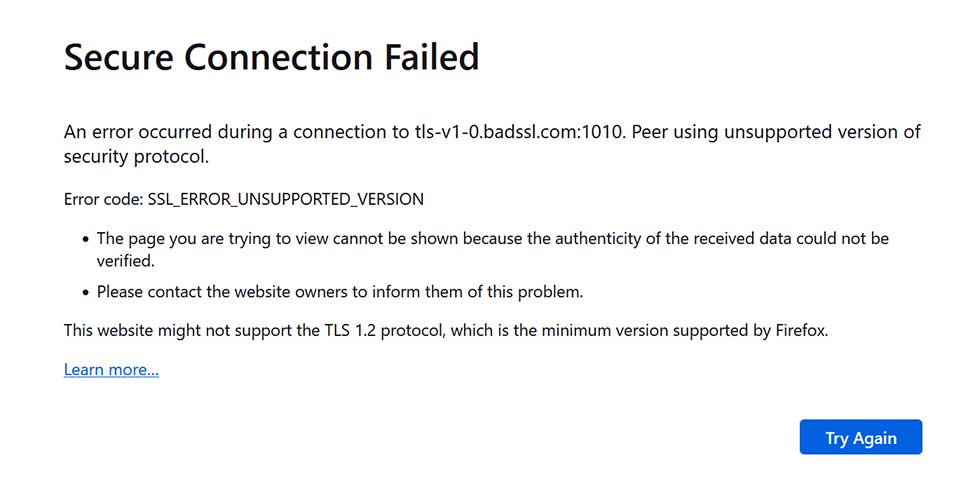
Image caption: A screenshot that shows how the SSL_ERROR_UNSUPPORTED_VERSION SSL protocol version error displays in Firefox.
The OpenSSL error typically appears when a client is requesting use of a protocol version that the server doesn’t support.
For website users, this SSL error message goes away on its own after refreshing the page, but sometimes it doesn’t and comes back repeatedly.
What Causes the SSL Protocol Errors
The error message ERR_SSL_PROTOCOL_ERROR can be due to different reasons, such as an issue with your WordPress website server, local computer, or even a combination of both. It’s among the most common SSL error messages, but it’s based on different reasons. So, sometimes trying to figure out how to fix it can be annoying.
That’s why we wrote this which focuses on fixing the issue. Here we’ve got a quick troubleshooting guide that will help you fix EER_SSL_PROTOCOL_ERROR on Google Chrome. If one doesn’t work, then you can look at the next one. Indeed, one will help you fix this error message and get rid of the issue.
How to Fix the ERR_SSL_PROTOCOL_ERROR (A Guide For Site Owners)
- Check TLS version support in your server configuration settings. This will help you determine which version(s) of TLS it supports (i.e., ensure that it also supports TLS 1.2). You can easily check which versions of the protocol are supported using Qualys’ SSL Labs SSL Server Test tool.
- Check your OpenSSL.conf file protocol settings. See whether any settings are specified for a minimum or maximum TLS version.
- Enable your server to employ a secure TLS version. For example, set it to use TLS 1.2 as a minimum.
How to Fix the ERR_SSL_PROTOCOL_ERROR (A Guide For Site Visitors)
Go through the below steps one by one, and we assure that one will help you solve the “This site can’t provide a secure connection” error message from Google Chrome.
Correct Your System’s Region, Date & Time
Sometimes, the simplest answer is the best one. Simply verify whether your system’s region, date, and time are correct or not. If it’s not correct, then rectify it with the correct one.
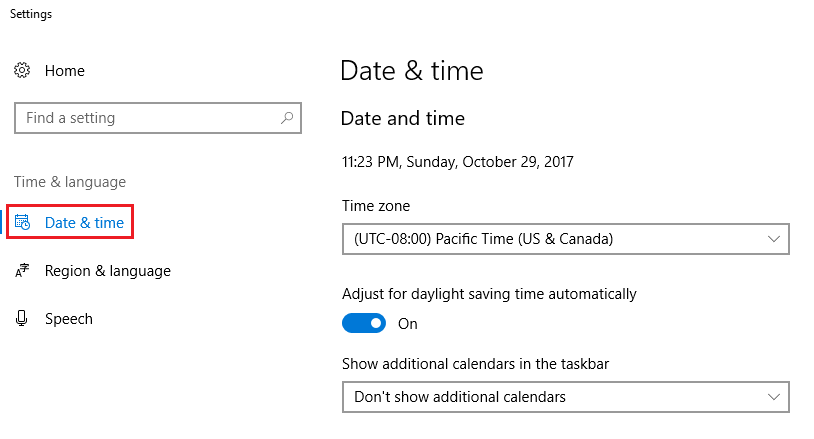
How come the system’s date, time, and region can become a problem? Well, the validity of an SSL/TLS certificate is a critical factor for the authentication process. It means keeping tabs on the time the SSL/TLS certificate was signed and when it’ll expire. So, issues may arise relating to certificate verification when your system’s date and time are out of whack.
Web browsers are designed in a way that it creates an error message like “This site can’t provide a secure connection,” also called “ERR_SSL_PROTOCOL_ERROR,” so users will know there’s something wrong. Henceforth, even a simple reason like the wrong date or time can create this SSL connection error.
Clear Google Chrome’s Cache & Cookie Files
If the ERR_SSL_PROTOCOL_ERROR persists, try clearing Google Chrome’s cache and cookies files.
Click Ctrl + Shift + Delete and clear all the browsing data. Usually, the first step or this second step solves the “This site can’t provide a secure connection” error. However, if you’re still facing this issue, then go to the third step.
Clearing SSL State to Resolve ERR_SSL_PROTOCOL_ERROR
If the above steps haven’t worked and you’re still facing ERR_SSL_PROTOCOL_ERROR, then try clearing your SSL state with the below-mentioned steps.
- Go to Start >> Control Panel >> Network and Internet >> Network and Sharing Center.
- Click Internet Options.
- Once Internet Properties opens, select a tab named Content and select the option Clear SSL State.
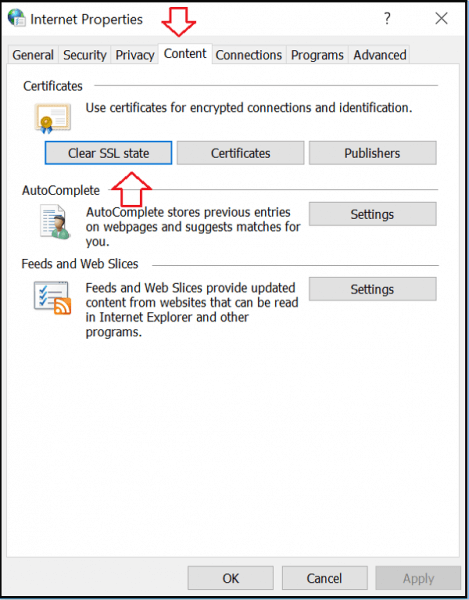
Once you complete the above step, it’ll solve the ERR_SSL_PROTOCOL_ERROR issue, and if it doesn’t, then go through the below step.
Disable QUIC Protocol to Resolve ERR_SSL_PROTOCOL_ERROR
QUIC abbreviation of Quick UDP Internet Connections offers an SSL/TLS type of connection to Google’s server. In select cases, disabling this option may resolve the “This site can’t provide a secure connection” or ERR_SSL_PROTOCOL_ERROR issue. However, in most cases, this approach won’t eliminate the error.
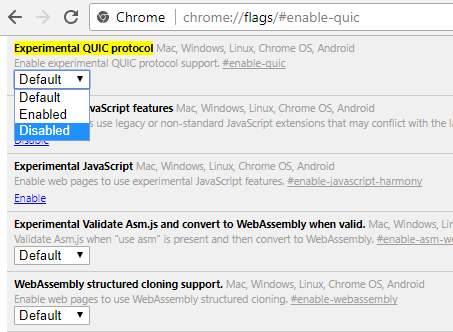
Below are the steps to disable QUIC protocol:
- Once you open Google Chrome, copy and paste: chrome://flags/#enable-quic in the address bar and hit enter.
- It’ll open the Experimental QUIC Protocol. It’s Default or Enabled. Click on it, and from the drop-down menu, select Disabled.
- Now, go to the bottom of the webpage and click the button Relaunch Now.
If this issue is a client-side error, then it should resolve the ERR_SSL_PROTOCOL_ERROR issue. If it doesn’t, it’s time to reach out to the website’s admin and let them know about the issue you’re running into (in case they’re not yet aware).
What Not to Do to Resolve ERR_SSL_PROTOCOL_ERROR
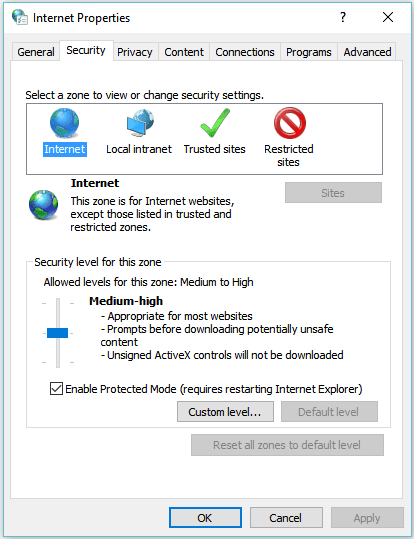
Lower Internet & Privacy Level
Some guides online will tell you that your security level is set too high and that you should lower it to resolve this error. Quite frankly, this is some crappy advice. Don’t lower your security standards and leave yourself at risk to cyber threats.
Disable Security Tools Like Antivirus for a Moment
Again, this is one of those recommendations that some companies put out that should be ignored. Yes, sometimes an installed Antivirus or Windows Firewall creates an issue. However, that doesn’t mean you should disable these tools in order to access a website. It’s a bad idea that leaves your systems vulnerable.
Wrapping Up This Article on How to Fix ERR_SSL_PROTOCOL_ERROR
Google Chrome does show SSL errors from time to time. And the “This Site Can’t Provide a Secure Connection” AKA “ERR_SSL_PROTOCOL_ERROR” is no different. Here, we’ve went over a few different steps, and out of them, at least one will certainly solve your SSL error. If it persists, then we suggest getting help from your SSL provider. If you’re a site visitor, you can certainly wait and visit after some time to see if it’s working or not.
WordPress SSL Certificates
Enhance your WordPress website security with a WordPress SSL certificate in a few minutes. It comes from a globally trusted Certificate Authority with 256-bit SSL encryption, $10K-$50K warranties, Daily WordPress security scans, and more.
Shop WordPress SSL Certificates
Editor’s Note: This article was originally published in May 2021. It was updated to provide more current information in April 2025.